The first edition of VN’s first novel in English, The Real Life of Sebastian Knight, is a bibliographic hybrid in ways I wasn’t fully aware of in the 1980s when I was pulling my bibliography together. Published by New Directions in 1941, TRLoSK, I have determined, was issued in anywhere from five to eight possible combinations of bindings, labels, and dust jackets. (I say “five to eight” because there may be as many as three black swans in the forms of different binding/label/dust jacket combinations but which I haven’t yet found to exist.)

Publication Date

Before getting to those combinations, let’s look for a moment at the publication date.  A number of copies (I see three for sale right now on the internet; I have examined many others), all in the red, rough burlap cloth, have

PUBLICATION DATE
________________

stamped on the front free endpaper and always the one date of “DEC 12 1941” separately stamped on the underlining. (I can get very picky here. I’ve seen the date in two different stampings, one with the “12” in the same font as the “1941” and one with the “12” in a different font. All of the “DEC”’s and “1941”’s are the same. This implies that at least in some cases a single date consists of at least two separate physical stamping actions. But since it is not unusual for a review or pre-publication copy of a book to have been distributed in slightly or even subtly different forms, I’m going to ignore these differences here.)

The U.S. Copyright Office lists a publication date of 6 December 1941. Brian Boyd (Vladimir Nabokov: The American Years, p. 40) gives an 18 December date. (Boyd tells me that this is “less than robust”; it is the date of the novel’s first review, “by Nabokov’s friend Amy Kelly in the Wellesley College News”.) And one copy with the stamped publication date has, in addition, a handwritten “12/5/41”.

Of course, what really counts as a publication date is when the book is offered for sale before the public (as Carter points out in his clear-headed ABC for Book Collectors). I don’t yet know exactly when TRLoSK was placed on sale, probably sometime in the first half of December. Until I turn up clear evidence (ads, publisher’s records), I am going to stand consistent and stick with the date I used in my bibliography: 6 December 1941.

Bindings, Labels, and Dust Jackets

Back to bindings, labels, and dust jackets. They come in a triplet of pairs.

The Real Life of Sebastian Knight, short-line label

The Real Life of Sebastian Knight, rough cloth with short-line label

The Real Life of Sebastian Knight, long-line label

The Real Life of Sebastian Knight, smooth cloth with long-line label

BINDINGS: Rough cloth or smooth cloth. Well-known and very clear differences, here shown with labels and their measurements.

The Real Life of Sebastian Knight, short-line label

The Real Life of Sebastian Knight, detail of short-line (2.7 cm) label

The Real Life of Sebastian Knight, long-line label

The Real Life of Sebastian Knight, detail of long-line (3.0 cm) label

LABELS: Short line or long line. The two different front-cover labels are physically the same size, 6.1 X 5.8 cm. The leafy borders are also the same size, 5.0 X 4.5 cm. But the text lines are different lengths. One is about 2.7 cm. long, the other about 3.0 cm. In fact, a close examination shows that the fonts used on the two labels are slightly different. In particular, look at each “a”, “e”, “i”, “g”, “R”, and “s”.

The Real Life of Sebastian Knight, dust jacket, front, “Nabokov” variant

The Real Life of Sebastian Knight, dust jacket, front, “Nabokov” variant

The Real Life of Sebastian Knight, dust jacket, front, “Nabokoff” variant

The Real Life of Sebastian Knight, dust jacket, front, “Nabokoff” variant

DUST JACKETS: “Nabokov” spelling or “Nabokoff” spelling. One variant dust jacket has the author’s name spelled “Nabokov” throughout, his first name spelled “Vladimir” at the top of the front flap, and the small heading “Other New Directions Books” on the back flap. The other variant has “Nabokoff” throughout, his first name misspelled “Valdimir” on the front flap, and the small heading on the back flap is “NEW DIRECTIONS FICTION”.

We know from the publisher’s records that New Directions printed 1500 copies of TRLoSK in 1941, but bound only 749 for distribution at that time. The balance of the printing was put into a warehouse and only bound and issued for sale in 1945. That is why all binding variations of TRLoSK are exactly the same internally with VN’s name spelled “Nabokov” on the title page. All evidence points to the first issue being bound in the rough red cloth and the second being in the smooth red cloth.

I have found so far that all paper labels spell the author as “Nabokov”. But the short-line labels appear only on the first issue. A mixture of labels with the two different line lengths appears indiscriminately on the second issue. In addition, I have found that the initial binding in the rough cloth is always wrapped with a “Nabokov” dust jacket. But only in the second binding in smooth cloth does the spelling “Nabokoff” appear on some dust jackets.

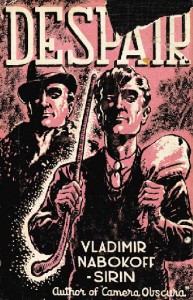
What does this mean? The fact that Nabokov’s name is often spelled in English with an “ff” before the 1940s (on the 1936 John Long Camera Obscura and the 1937 John Long  Despair as “Nabokoff-Sirin”, on the 1938 Bobbs-Merrill Laughter in the Dark) and consistently with a “v” beginning sometime in the 1940s implies that the first designed and printed dust jacket was probably the one with the “ff” and the misspelled first name on the front flap. But the first issued dust jacket was the one with the “v”. Did the publisher first have the “ff” jacket printed, pick up on the mistake, put it aside, redesign and print the “v” jacket, and use it for the first issue? And then during the second issue four years later, did the publisher instruct the binder to use the “ff” and the “v” jackets indiscriminately? That’s one possibility.

In summary, these are the observed combinations:

  • Rough cloth, short-line labels, “Nabokov” author, ( with a stamped publication date on some copies).
  • Smooth cloth, short-line labels, “Nabokov” author.
  • Smooth cloth, short-line labels, “Nabokoff” author.
  • Smooth cloth, long-line labels, “Nabokov” author.
  • Smooth cloth, long-line labels, “Nabokoff” author.

These are the priorities of issuance:

  • Rough cloth over smooth.
  • Short-line labels over long.
  • “Nabokov” over “Nabokoff”.

And these are the conclusions:

  • Original printing: 1500 copies printed by the Walpole Printing Office, Mount Vernon, NY in November 1941.
  • First issue: December 1941.
    • Binding: 749 copies in red, rough burlap cloth.
    • Labels on cover and spine: short-line.
    • Dust jacket: author’s name spelled “Nabokov”.
    • (Publication date stamp on a small number of review copies.)
  • Second issue: April 1945. Binding: 751 copies in smooth red cloth.
    • First variant –
      • Labels on cover and spine: short-line.
      • Dust jacket: author’s name spelled “Nabokov”.
    • Second variant –
      • Labels on cover and spine: short-line.
      • Dust jacket: author’s name spelled “Nabokoff” (and the author’s first name on the front flap spelled “Valdimir”).
    • Third variant –
      • Labels on cover and spine: long-line.
      • Dust jacket: author’s name spelled “Nabokov”.
    • Fourth variant –
      • Labels on cover and spine: long-line.
      • Dust jacket: author’s name spelled “Nabokoff” (and the author’s first name on the front flap spelled “Valdimir”).

Copies of TRLoSK in both bindings are relatively easy to come by. But copies with either dust jacket are much harder to find and dearer to buy.

Tags:

After much vacation and many travels, I’ve returned to the blog. And my first posting has nothing to do with bibliography, something to do with VN, and more to do with a favorite VN pastime, word games.

From yesterday’s (31 August 2009) New York Times, Science Section, “After the Transistor, a Leap Into the Microcosm” by John Markoff, third paragraph, third sentence: “The leaking electrons make it more difficult to know when a transistor is in an on or off state, the information that makes electronic computing possible.”

Have you ever seen five two letter words (here, “is in an on or”) used consecutively (and unconsciously, I presume) in one sentence in a piece of journalism? And even more startlingly, the five form, in their written order, a perfect “word golf” sequence, from “is” to “or”.

As you certainly know, word golf was a hobby of John Shade, the American poet who was (or perhaps wasn’t) killed by Jakob Gradus in Pale Fire. A word golf solver takes a starting word and creates a chain of successive words by changing only one letter at each step, until he/she has reached the target word. As Charles Kinbote points out, you can do a word golf sequence with hate-love in three steps, lass-male in four (lass-mass-mars-mare-male) and live-dead in five (with “lend” in the middle).

The five-word is-or sequence is obviously not the shortest possible, as word golf calls for. You could do it in two steps if you use the slightly uncommon word “os” as the intermediary. There are other possibilities. But the point here is that it was done by chance.

Playboy wins. VN’s old stomping ground, the first serial-rights publisher of many of his works, has this time acquired the first serial rights to The Original of Laura. The news was detailed yesterday in The New York Observer.

Knopf will publish the full work in November, on either the 3rd or the 17th, depending on your source. The New Yorker, another magazine VN had a long relationship with, was expected to grab the rights. But, according to the Observer story, the magazine’s fiction department turned it down. I suspect that Andrew Wylie, Nabokov’s agent, was asking for too much money. Or they didn’t want to publish such a fragmentary work as TOoL certainly is. Remember that the novel is subtitled “A novel in fragments”.

The most interesting part of the Observer story is the fact that Playboy plans to run the excerpt in its December issue—which would hit the stands on 10 November, a week before Knopf issues its book—to the length of 5000 words. That’s a big chunk—half of the 10,000-word manuscript.

Mixed in with those 10,000 words are emendations in brackets by the transcribers of the cards, annotations by VN, and notes by his son Dmitri. Of the 138 cards on which VN composed the fragments of his novel, 63 are marked as the first five chapters (Ch. 1, cards 1-20; Ch. 2, 21-38; Ch. 3, 39-49; Ch.4, 50-53; Ch. 5, 54-63). Cards 64-78 and 79-87 are provisionally noted as chapters 6 and 7. Cards 88-92 are headed (by VN? by an editor?) “Medical Intermezzo”. And there is a “[Last Chapter]” comprising cards 93-138. However, after the first two cards of the “Medical Intermezzo” (88 and 89), a provisional ending, based on VN’s annotations, has been constructed from cards 93-94 and 112-114. Apparently because VN annotated cards 112-114 with the letter Z,  it is called chapter 26.

It is clear that TOoL is truly “a novel in fragments”. And the fragments contain only eight chapters (plus an intermezzo) of the supposed 26 chapters of the fully-imagined novel. This assumes, of course, that I haven’t missed the train that this project is travelling on and that the elements I describe haven’t been changed by the editors.

Tags:

More information has emerged about the fraudulent VN-inscribed books on eBay. The rare book dealer who bought one from the online auction site recently points out that the perpetrator of the fraud has used other online identities and is fighting return of the payment.

Brainerd Phillipson, the rare book dealer in Holliston, MA, has sent me a follow-up email with information from Ivo de Galan, another person who has had dealings with the forger. Phillipson wrote me:

This morning [25 June] I received the following email from Ivo de Galan informing me that he knew about the fake Nabokov “ADA” early on. Apparently, the work was done by a group of forgers who have been preying on eager collectors.

Here is the email Phillipson received from de Galan:

The book from Nabokov, is indeed a fake. For well over a month I’ve been telling ebay they are the former pepperberry08 famous for forging autographs. Last year they were caught redhanded, and this is their new id. Sadly eBay does not care about my telling them. They stole 342 from me, and need to be stopped. (for the amount of fraud they commit is tens of thousands, these are big time crooks.

Sorry about your loss, which could have been avoided if eBay would have listened…

Phillipson wrote back to de Galan:

Thank you very much for your timely information about the fake Nabokov inscription in “ADA.” Once I ascertained that the book was a fake, I returned it in exactly the same condition, only to have the seller Carlos Melgar (Vivafandango) claim that it was not the same book. He is currently appealing.
However, PayPal has been very supportive in covering my initial loss, and I have forwarded your email to them.

Again, I strongly urge anyone who sees an inscribed VN book on eBay, or any other such site, to look at the item very, very carefully before making a commitment to buy it. Ask for the provenance and quality photos of the book first. Look at the seller’s response skeptically. Send email inquiries to dealers and collectors who are familiar with VN material. Send me an inquiry. Post a comment to this blog. The odds are very high that someone selling a VN-inscribed book in an unvetted public (that is, non-dealer, non-personal) marketplace is perpetrating fraud.

Tags: ,

The Library of Congress today is making available to the public a set of VN papers that had been, with Dmitri Nabokov’s permission, restricted to researchers until now. Is it really true, according to an LoC statement some years ago, that the Nabokov writings in it will be in the public domain?

In 2004, the LoC said that the papers were in containers 1-20 and OV-1. A detailed list of containers 1-15, called a “complete listing”, was published in 1980 by The Vladimir Nabokov Research Newsletter (now The Nabokovian), IV, pp. 20-34. The current LoC online catalog describes the collection as containing in full 7000 items in 22 containers and one oversized container and 13 reels of microfilm dating from 1918-1974. I cannot account for the discrepancies (15 or 21 or 23) in the container counts.

Here is the beginning of a link to the LoC records.

Tags: ,

The Original of Laura cover design

The Original of Laura cover design

Knopf has unveiled an outstanding cover for the forthcoming posthumous publication of VN’s The Original of Laura in November. The website doesn’t mention the designer.

Besides the hardcover version, there will a library edition with “nonremovable cards”. That means that the trade edition will include index cards of the printed text in the way VN wrote his later works, or the cards will be facsimiles of the originals. Knopf is also issuing an “eBook” version. Amazon.com says that the book is so far not available for its Kindle reader. I assume this means it will be available for the Sony Reader.

The Knopf website, possibly mistakenly, states that the the trade hardcover and the eBook will be issued on 17 November this year but that the library binding will be issued on 3 November, the date the publisher originally gave and the date that amazon.com still has.

The latest details:

  • Trade hardcover, 288 pages, on sale 17 November 2009, $35.00, ISBN 978-0-307-27189-1 (0-307-27189-7).
  • eBook, 288 pages, on sale 17 November 2009, $35.00, ISBN 978-0-307-27325-3 (0-307-27325-3).
  • Library edition with nonremovable cards, 288 pages, on sale 3 November 2009, ISBN 978-0-307-59275-0 (0-307-59275-8).

Tags: ,

They just keep rolling along…bogus VN inscriptions, that is. Vincent McDonough points out that “books4charities-2008” listed on eBay yesterday a “VN-signed” copy of the Fall 1967 issue of Paris Review with the VN interview inside. books4charities-2008 listed and successfully sold a “VN-signed” 1968 copy of King, Queen, Knave on 15 April on eBay. Take a look quickly. The bidding on the 24-hour-only, bidder-ID-kept-private, no-provenance-given auction ends this afternoon.

I sent a query to the seller. He answered quickly:

This was acquired at the Santa Monica book fair from a reputable dealer. From looking at other known exemplars in our own collection and that of others we believe this to be an authentic signature. We put our trust in the book dealer as well as our own experience.

This is essentially the same answer I got when I asked about the inscribed King, Queen, Knave in April. That also came from the Santa Monica book fair.

Actually I can’t tell for certain if the offer is the real thing because the photo of the signature is small and smeared. But all other evidence points to bogusness here.

Tags: , ,

On 25 May on eBay, a seller with the ID of “vivafandango” sold an inscribed copy of the 1969 Ada with a butterfly drawing for $1375. On 21 May, before the auction had closed, I posted a piece here about the dubious authenticity of the inscription and drawing. My skepticism has been borne out. Here is the story so far.

When I saw the listing (first pointed out by Vinnie McDonough), I wrote to vivafandango and asked three questions:

  • “Could you post a clear, sharp, full picture of the inscription? The picture you posted is too blurry.”
  • “What is the provenance of the book?”
  • “Who or what is the Certificate of Authenticity from?”

I received prompt answers:

  • “Please see the description. I have added some details. I will not be able to send you a picture until Monday as I am away from home for a long week-end. There are floods in New South Wales and I have a house in Lismore which is endangered. Best Regards and thanks for your interest.”
  • “See my additions to description. Thank you.” The additions were, “COA issued in 1981 by Le Monde de l’Autographe (Paris). I bought this book from Anton Boulanger (nephew of Nadia Boulanger) in Lausanne in 1987.”

The photos, the critical photos,  never appeared.

On 8 June, Brainerd Phillipson, a dealer in Holliston, MA, posted a comment to my original item saying that he had won the book on eBay, had paid for it, and had just received it in the mail. He was having real doubts about its authenticity.

…I would love to see your close-up photos of the signature and butterfly. As the author of the standard VN bibliography, I have seen many VN signatures and drawings. Saying that, I must point out that I have only experience and not expertise. But I have developed a sense of what is authenticate VN and what isn’t. It is based on many elements. Please look again at my blog posting of 15 April.

The book you bought has the additional dubiousness of appearing to be a copy of the artificial hybrid VN drew for his wife for Christmas 1969 in a copy of King, Queen, Knave. I must say that I have never seen or heard of VN repeating himself in this fashion, especially repeating something for the person closest to him in his life.

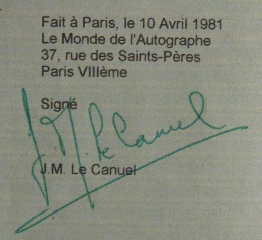
In addition, can you determine the authenticity of the Certificate of Authenticity? Does J.M. Le Canuel exist? Did it ever? And did you ever wonder why you got the book so relatively cheaply? Other potential buyers shied away from bidding on the book because they felt as I do: It just didn’t feel authentic.

As I said, I would very much like to see your photos (including one of the certificate of authenticity) so that I can give you my further opinion. I must say, however, that I don’t think that anyone I know (with the exception of Dmitri) can say with absolute certainty that a particular VN inscription is or is not authentic. Personally, I feel that the best certitude comes from having a clear and complete line of provenance.

Mr. Phillipson replied:

…Yes, I wondered how I managed to win the book on the Ebay auction with such a low bid, but I have been lucky before and acquired some lovely first editions (real!) on Ebay in the past. Also, I originally doubted the butterfly drawing from the beginning, but the signature and other writing looked “right.” And when I saw the spectacular fusion of butterflies in the “Nabokov Butterflies” book translated by Dimitri, I felt it might be actually authentic. That is until I received the book. The drawing and the writing definitely did not feel correct.

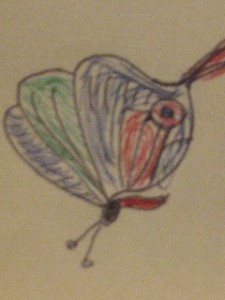
There are too many inconsistencies in the letters, which just do not look like the genuine writing of VN that I have seen. And the butterfly drawing is amateurish.

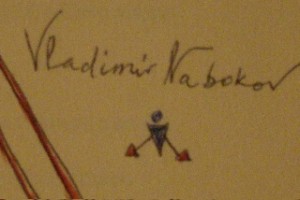
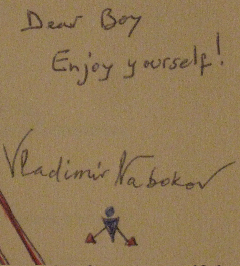
Also, there’s the matter of the little triangular symbol beneath his signature. Have you ever seen it before?

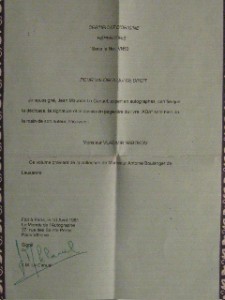
The COA is just a photocopy that appears to be signed in green ink by Jean Maurice Le Canuel of Le Monde de L’Autographe, Paris.

Here are the photos for your consideration.

And here they are:

The inscription with an odd triangular figure.

The inscription with an odd triangular figure.

A larger picture of the signature.

A larger picture of the signature.

Detail of the drawing.

Detail of the drawing.

The full CoA.

The full CoA.

The signature on the CoA.

The signature on the CoA.

I wrote back to Mr. Phillipson.

I’ll take this one step at a time:

  • Signature – I agree that it looks awkward and doesn’t flow as a real signature would. The “b” in the surname is not formed the way VN normally did it.
  • Icon – That triangular thingie is totally new to me. I can’t imagine what it might mean.
  • Inscription – It does not at all sound like VN. I don’t think he would say “Dear Boy” and not use a name. And “Enjoy yourself!” is totally not VN’s voice: too flat, cliched, and meaningless. Also,the “Enjoy yourself!” is written in jerky block letters without the kind of flow VN’s hand always had.
  • Drawing – Yes, as you say, very amateurish. VN took great pride in his knowledge of lepidoptera and his rendering of them. The part that you show me is not his drawing.

I’m even more convinced now that it is all bogus. I’m sorry that you took the leap and lost. I hope that you can get your money back. And I think that something should be said to eBay.

And Mr. Phillipson wrote back:

I have initiated a “dispute” through PayPal, and I am returning the book for a full refund. I will let you know how the matter is eventually resolved.

I go into such detail here because so many fake VN inscriptions and drawings are being offered on the internet, people and dealers are being taken in, and those authentic inscriptions are being corrupted by association. Bad books drive down the value of the good.

I would appreciate hearing about other experiences with fake VN’s. Or even from readers who have questions about the authenticity of their own signed copies. And I have two questions: Has anyone ever seen that triangular thingie before? And did Nadia Boulanger have a nephew named Anton and who knew VN?

Tags: , ,

Despair, John Long, 1937

Despair, John Long, 1937, (Christie’s 17 April 2001)

I’ve found another jacketed copy of the 1937 John Long Despair buried deep in my online notes and jpgs. It was auctioned at Christie’s on 17 April 2001 and was knocked down at $18,800 (including buyer’s premium). I don’t have an image of the spine and Christie’s description doesn’t mention it. So I don’t know if it had a price of 7/6 or 3/6.

That’s three dust jackets and counting. In the meantime I’m waiting for Washington University in St. Louis to find its own copy. I am told that it is misshelved somewhere in its special collections.

Vinnie McDonough has pointed out what looks very much like another fake VN inscription from the world capital of fake VN inscriptions, Australia. It is being offered on eBay.

It is a copy of the 1969 McGraw-Hill Ada with a drawing similar to what VN did for Véra for Christmas 1969 of a Hairstreak with Australian Lacewing tails. That original was done in a copy of King, Queen, Knave in Russian that McGraw-Hill published in 1969. You can see it on the front-free endpaper of Vladimir Nabokov: Selected Letters 1940-1977.

I’ve asked the seller for further information (clearer photo, provenance, details of the alleged Certificate of Authenticity) but I don’t really expect a response.

Tags: , ,

« Older entries § Newer entries »