Exactly what is, to use the popular locution, the “first edition” of Lolita in Spanish? Or, more precisely, who issued the first Spanish translation, when was that, and in what form did it appear?

There are three candidates, each published in 1959:

  • An authorized translation by Enrique Tejedor, issued by Victoria Ocampo’s Sur in Buenos Aires.
  • An unauthorized issue by Diana in Montevideo.
  • An unauthorized issue by Azteca in Mexico, D.F. (Mexico City).

Let’s deal with the latter two first. I got those citations originally from Dieter E. Zimmer’s Vladimir Nabokov: Bibliographie des Gesamtwerks (Rowohlt, 1963, revised 1964). Andrew Field’s notoriously inaccurate and oddly organized Nabokov: A Bibliography (McGraw-Hill, 1973) also has them, probably picked up from Zimmer. I can find no other citations nor copies of the books in dealers’ hands or on libraries’ shelves. Until further evidence is turned up, I am here going to make the totally unsupported but logical assumption that the publishers, Diana and Azteca,  did not commission their translations but simply stole Tejedor’s when they saw that a quick and easy peso could be turned by publishing the very hot novel themselves. That is, they pirated the translation.

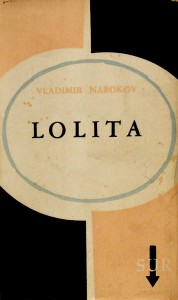
Lolita, Sur, 1959
Lolita, Sur, 1959

I know nothing about Victoria Ocampo other than what Wikipedia tells me. The key information in the article is that “she was founder (1931) and publisher of the Argentine magazine Sur, the most important literary magazine of its time in Latin America.” Her roster of writers is very impressive (Borges, Sabato, Bioy Caesares, Cortázar, Ortega y Gasset, and so on). Her publishing Lolita, therefore, is not surprising.

Sur issued Lolita three times in wrappers in 1959, each with the same cover. The colophons of the books show they were printed on 24 April, 29 May, and 10 June. I know that the 29 May printing also had a paper-over-boards binding. So, when you see a dealer offering a Spanish “first edition” of Lolita, be sure to first check the colophon. It should read, “la presente edición | se terminó de imprimir | el día 24 de abril de 1959 | en Talleres Gráficos Torfano | castro barros 130, | buenos aires, | argentina”.
Lolita, Sur, 1961

Lolita, Sur, 1961

It was reissued in wrappers (different cover and slightly smaller format) in 1961 as number 18 in the series “Novelas”. That edition has the statement at the bottom of the front flap, “Prohibida su venta en el municipio de Buenos Aires.” Oddly, I have no evidence that Lolita was printed in Spanish between 1961 and its next issue in 1970 by the Mexican press Grijalbo.

So, in summary, this is what we’ve got for the first publications of Lolita in Spanish:

  • Printed 24 April 1959, published by Sur in Buenos Aires, in wrappers, translated by Enrique Tejedor [examined].
  • Printed 29 May 1959, published by Sur in Buenos Aires, in pictorial boards, translated by Enrique Tejedor [examined].
  • Printed 29 May 1959, published by Sur in Buenos Aires, in wrappers, translated by Enrique Tejedor [examined].
  • Printed 10 June 1959, published by Sur in Buenos Aires, in wrappers, translated by Enrique Tejedor [examined].
  • Issued in 1959, published by Diana in Montevideo, probably pirated, translator unknown but probably Tejedor [not examined].
  • Issued in 1959, published by Azteca in Mexico City, probably pirated, translator unknown but probably Tejedor [not examined].
  • Printed 17 May 1961, published by Sur, in series “Novelas”, number 18, in wrappers, translated by Enrique Tejedor [examined].
  • Unknown printing date, published by Sur, in series “Novelas”, number 18, unknown binding, possible “enc.” edition, translated by Enrique Tejedor [not examined].
  • Printed 30 March 1970, published by Grijalbo in Barcelona, in wrappers, translated by Enrique Tejedor [examined].
Tags: , ,

I found two VN-connected but non-VN items at the New York Antiquarian Book Fair and heard a birthday story.

Kelmscott Bookshop (Baltimore, MD) had an attractive copy of Russian Wonder Tales translated by Post Wheeler, Secretary of the American Embassy in St. Petersburg for $75. It was published in London by Adam and Charles Black in 1912 with a dozen illustrations taken from the work of the very well-known Ivan Bilibin. (Harvard University Library has an American-issued copy (The Century Co., New York, 1912), rebound without the pictorial boards. Google Book Search has it on line.) I wonder if there is a VN connection here, as slight as it might be. Did the Nabokov family know Wheeler, Bilibin, this book?

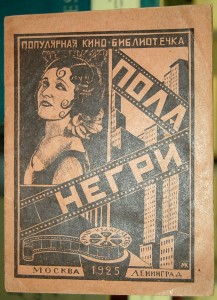
Pola Negri, 1925

Pola Negri, 1925

Peter Harrington (London) had an outstanding copy of one of the two fragile little pamphlets on Hollywood published in the 1920s in Russian by VN’s fellow St. Petersburgian, Alisa Rozenbaum. That is, Ayn Rand. Пола Негри [Pola Negri] carries no author credit, is 16 pages, and measures 15 x 11 cm. This copy is the first of the two printings and in pink wrappers. Price, a not so fragile £6750/$10,125. How far those two such different writers came in their adopted country.

John Rutter of Ars Libri (Boston, MA), a specialist in art books and a dealer who knows his VN stuff, told me a story about his 17-year old daughter. Her birthday was coming up soon and John didn’t know what present to get her. Finally, he broke down and asked her directly what she wanted. She considered the question for a moment. Then she turned to her father: “I know how you feel about your books. So, could you get me my own copy of The Annotated Lolita so that I can mark it up?”

Tags:

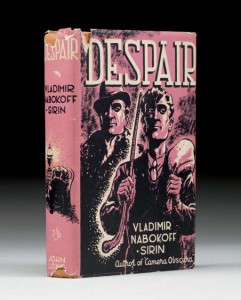
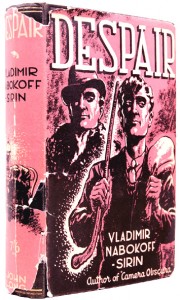
Despair, John Long, 1937 (Courtesy of Peter Harrington)
Despair, John Long, 1937 (Courtesy of Peter Harrington Books)
Despair, John Long, 1937
Despair, John Long, 1937 (Christie’s 19-Jun-2007)

The juiciest VN piece at the New York Antiquarian Book Fair was from Peter Harrington Books (London), a copy of VN’s translation of Despair published by John Long in 1937 (Juliar A15.2). Not so unusual without a dust jacket. But this copy was quite unusual—it has a dust jacket and was offered at £17,500/$26,250. A fair enough price, actually, considering its rarity.

Here are photos of two different copies with the same dust jackets: the Peter Harrington copy and one that Christie’s sold at auction on June 19, 2007. On the first one, you can see the black cloth peeking out of its dust jacket. That binding has gilt stamping, a blind rule bordering the front cover, and gilt rules at the top and bottom of the spine.On the second, the orange cloth binding is peeking out. It has black stamping with no rules on the front cover or on the spine.

I have no direct evidence yet, but I suspect that the dust jackets may come in two variants with two prices on the spine: 7/6 and 3/6.  I do know for certain that John Long’s earlier publication of Camera Obscura (Juliar D14.4) was labeled and sold at each of those two prices.

How many copies of the book are there? VN said in the foreword to his 1966 translation of the novel, “…the book sold badly…a German bomb destroyed the entire stock. The only copy extant is, as far as I know, the one I own…” We know today that multiple copies (countable in the dozens, I estimate) survive. But only a small number still retain their dust jackets. (I will try to get a color photo of the copy held at the Washington University Library in St. Louis.) It’s not many more than the four I’ve examined or seen photos of. They’re quite distinguishable in the same way individual right whales are by their callosities. Each surviving dust jacket has its own tears, rips, chips, and discolorations.

I would appreciate hearing about and seeing photos of other copies of the 1937 Despair in dust jacket. Also of Camera Obscura.

More

I have two more items from the fair, both non-VN, to write about and one story, in “VN at the NY Book Fair (4)”.

Tags: , ,

Three Russian editions and one American, inscribed by VN, none with butterflies, were offered at inconsistent prices at the New York Antiquarian Book Fair this year.

Invitation to a Beheading

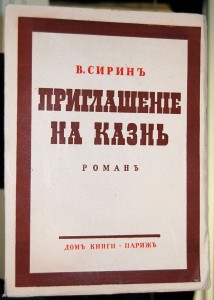
Priglashenie na kazn', 1938, cover

Priglashenie na kazn', 1938, cover

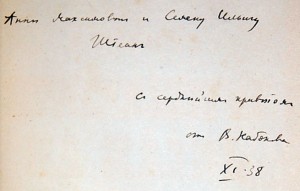
Priglashenie na kazn', 1938, inscription

Priglashenie na kazn', 1938, inscription

Bernard Quaritch of London had a Приглашение на казнь [Priglashenie na kazn’/Invitation to a Beheading], Paris, 1938, (Juliar A16.1), inscribed by VN in Russian, “To Anna Maksimovna and Semen Il’ich Shtein with a heartfelt hello from V. Nabokov. XI.38” (as translated by the dealer). The only reference I find to a Shtein in Boyd’s biography is in The Russian Years, p. 192, as a family friend, in reference to the day that VN’s father was killed. The book is in fine condition. It has one oddity: a mylar-like page bound into the book (not tipped in) between the front cover and the inscription on the first page. I may be able to learn more about it later from the dealer. Price, £8,000/$12,000.

Glory

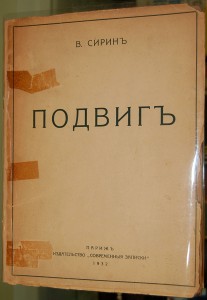
Podvig, 1932, cover

Podvig, 1932, cover

Podvig, 1932, cover
Podvig, 1932, inscription

Podvig, 1932, inscription

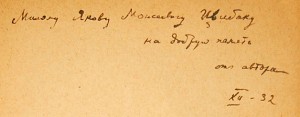
Lame Duck of Cambridge, MA, had a Подвиг [Podvig/Glory], Paris, 1932, (Juliar A13.1), inscribed by VN in Russian, “To my dear Jakov Mysevich Tzwibak with the fond memories of the author, XII.32” (as translated by the dealer). The description continues: “Andrei Sedykh (real name Lev Tzwibak), secretary of Ivan Bunin and editor-in-chief of Novoe Russkoe Slovo (The New Russian Daily) newspaper”. As you can see in the photo, the paper has begun acidifying and the tape residue across the spine and onto the cover are very unappealing. I would describe its overall condition as fair. Price, $27,500. I cannot explain why it is more than twice the price of the one from Quaritch. When in the market, always shop around.

The Real Life of Sebastian Knight

The Real Life of Sebastian Knight, 1941, cover

The Real Life of Sebastian Knight, 1941, cover

The Real Life of Sebastian Knight, 1941, inscription

The Real Life of Sebastian Knight, 1941, inscription

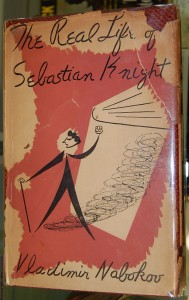
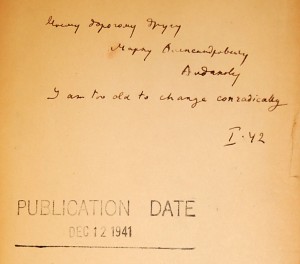
Lame Duck also had The Real Life of Sebastian Knight, New York, 1941 (the day before Pearl Harbor), (Juliar A21.1a), inscribed in Russian and English to Mark Aleksandrovich Aldanov. My ability to decrypt Russian script is minimal. I can make out only to whom the inscription is addressed and the English: “I am too old to change conradically | I.42”. The “Publication Date” stamping, normally indicating an advanced or review copy, is not uncommon for this book. The December 12th date may have been what the publisher anticipated but the U.S. copyright office has a December 6th date. The dust jacket is in woeful shape, missing half the spine and decaying from acidification. The binding is the red burlap-like cloth variant. Price, $27,500.

King, Queen, Knave

King, Queen, Knave, 1928, cover

Korol' dama valet, 1928, cover

King, Queen, Knave, 1928, inscribed

Korol' dama valet, 1928, inscription

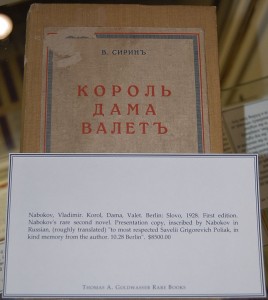
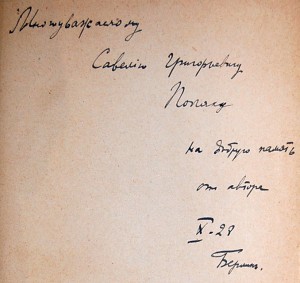
Though he has been trying to sell it for more than five years, I want to include here an item from Thomas Goldwasser (San Francisco, CA), Король, дама, валет [Korol’, dama, valet/King, Queen, Knave], Berlin, 1928, (Juliar A9.1), inscribed by VN in Russian, “To most respected Savelii Grigorevich Poliak, in kind memory from the author. X.28 Berlin” (translated by the dealer). It is rebound in cloth, with the front wrapper trimmed and glued to the cover and includes library stamps of the Russian Refugees’ Relief Association, London. Price, $8500.

More

I saw one juicy rarity that I need another posting to describe, in “VN at the NY Book Fair (3): The 1937 John Long Despair”.

Tags: , ,

On what would have been VN’s 80th birthday (using the traditional date), April 23rd, 1979, I bought my very first “first edition” at that year’s New York Antiquarian Book Fair. No, not a VN book, but John McPhee’s A Sense of Where You Are, his profile of Bill Bradley as a basketball player at Princeton, for $75. I have no idea if VN ever read anything by McPhee or if McPhee has ever said anything about VN. But I sense an affinity between the two writers: their passion for the precise use of language.

Almost thirty years later, on Friday afternoon, I wandered the aisles of the New York Antiquarian Book Fair at the Park Ave. Armory at 67th St. My McPhee shelf is essentially complete. But I am always looking for more VN.

Among the more than 220 dealers from across the country and Europe were several dozen dealers in modern literature or “first editions” offering, among their McPhee’s (not too many) and their VN’s (not too many either), very expensive cornerstone mysteries, very expensive popular novels that became landmark movies, very expensive high points in 20th century writing (it’s too soon yet to find any from this century), and very expensive dust jackets dressing up mere thousand dollar books into high society swells. And, yes, many were offering for the rest of us $25 and $50 books.

But it is the big boys who catch our eye. I’ve been peeking into the booths of this show for several decades and still know little about its behind-the-stalls goings-on. I still wonder where these dealers find some of their gems and how they have the gall to charge what they do. And then I think of how many times I would have laid down the cash I didn’t have just to posses one of their volumes. It’s a slightly awry world.

As far as prices go, VN was holding his own very well there. Some of the quality green Olympia Press Lolita’s were bumping up against the five-figure mark. (The following descriptions of condition are idiosyncratically my own and are not the terms dealers usually use.)

  • A 1955 Olympia Press Lolita (Juliar A28.1.1) at Buddenbrooks (Boston), worn and a bit banged up, for $4850.
  • Another Olympia Lolita at Ken Lopez (Hadley, MA), in very nice condition at $9500. An absolutely beautiful and bright 1958 Putnam Lolita (Juliar A28.2) for $5000. And an unpublished August 28, 1960 letter to Pyke Johnson Jr., an editor at Doubleday, returning a $2500 advance given to him for Pale Fire and asking that he be freed from his contract, at $4500.
  • Another very nice Olympia Lolita for $9000 at Between the Covers (Goucester City, NJ). Also a 1938 Bobbs-Merrill Laughter in the Dark in green cloth and a fine dust jacket (Juliar A14.2) for $7500.
  • A fine 1959 Weidenfeld and Nicolson Lolita (Juliar A28.3) at Crawford Doyle (New York, NY) for $500, bought by a fellow Nabokov collector who takes only the best.
  • A 1969 Weidenfeld and Nicolson Ada at Thomas Goldwasser (San Francisco, CA) with corrections in pencil by VN scattered about the book, $5000.

More

I made notes and took photos of a bunch of inscribed Russian editions. I’ll post that next in “VN at the NY Book Fair (2): Inscribed Copies”.

Tags:

A Moscow publishing house, Deich, issued a Russian Lolita in 2008 in a large format with a leather spine in a leather box, and with black-and-white illustrations, limited to 99 numbered copies, none hors commerce, ISBN 978-5-98691-042-0. Price: €1700. At the current exchange rate that’s more than $2250.

Tags:

The publication of The Original of Laura: (Dying Is Fun) is moving ahead. It’s listed on the Random House/Knopf website for release in November. You can pre-order it from amazon.com at $23.10 (discounted from $35.00) for November 3rd delivery (ISBN: 0-307-27189-7/978-0-307-27189-1). If you’re in Britain, amazon.co.uk is asking £22.22 for the same edition.

There is no dust jacket image yet. The Knopf blurb describes the 288-page package:

At last: Vladimir Nabokov’s final and unfinished novel, in print—thirty years after his death, years in which the fate of The Original of Laura was in constant and closely watched question.

When Nabokov died in 1977, he left instructions for his heirs to burn the 138 handwritten index cards that made up the rough draft of The Original of Laura. But Nabokov’s wife, Vera, couldn’t bear to destroy her husband’s last work, and when she died, the fate of the manuscript fell to her son. Dmitri Nabokov, now seventy-four— the Russian novelist’s only surviving heir, and translator of many of his books—has struggled for decades with the decision of whether to honor his father’s wish or preserve for posterity the last piece of writing of one of the greatest writers of the twentieth century. His decision finally to allow publication will be passionately welcomed by both scholars and general readers. And the ingenious format of the book (which includes removable facsimiles of the index cards) will make an even more extraordinary occasion of this publishing event.

In its fragmented narrative—dark yet playful, preoccupied with mortality—we are given one last experience of a writer’s unparalleled creativity, a glimpse of his last days, and a body of work finding its apotheosis.

The book will include a short introduction by Dmitri Nabokov. In addition, Knopf is issuing an “eBook” version (ISBN: 0-307-27325-3/978-0-307-27325-3) at the same price to be released also in November. There’s no mention of the eBook on amazon.com.

I have no information on foreign language rights. I wonder if The New Yorker is going to take on serial rights. The Nabokovian, in a real sense, already has taken the first serial rights (see No. 42/Spring 1999, pp. 34 (#2) & 37 (#5)).

A voice hums in my head: Laura is a wild and florid set of fragments. And then I hear: The book, he answered, is a novel too—at least, after a fashion.

Tags:

Again with help from Andrey Nickolayenko and this time from Tatiana Ponomareva, director of the Nabokov Museum in St. Petersburg, I’ve received further information about the Ukrainian Lolita. It was translated from the Russian by Peter Taraschuk and published in Kharkov by Folio in 2008 in a run of 1250 copies. It may not be an authorized edition. More is at gazeta.ua.

Tags: , ,

With the kind and quick help of Andrey Nickolayenko and Tamriko Kvachadze, I’ve learned a bit more about my Georgian copy of Lolita (see my 18 March posting). It was translated from the Russian by Tamar Lomidze and published by Logos in Tbilisi, Georgia in 2002. It includes the three addenda that should be part of all Russian editions and translations from the Russian: VN’s original English afterword, his Russian postscript, and his Russian list of foreign terminology in the novel.

Tags: , ,

A friend in Moscow tells me a Lolita in Ukrainian was published in 2008. Does anyone have details? In fact, has any other VN work been translated and published into Ukrainian? I know of none.

Tags: , ,

« Older entries § Newer entries »